

A disc dryer is a highly efficient and energy-saving conductive continuous drying device. The equipment mainly includes a shell, frame, large and small hollow heating discs, main shaft, rake arms and blades, feeder, unloading device, reducer, and motor. The following examples illustrate the application areas of disc dryers:
I. Drying of Toxic and Easily Escaped Materials
Environmental protection is one of the fundamental national policies. In chemical and related industries, it is common to encounter situations where the dried materials contain toxic substances or have extremely fine particle sizes that escape with the exhaust gas. Without appropriate measures, this will pollute the environment and harm the health of operators. To enable disc dryers to be suitable for drying toxic, harmful, and environmentally polluting materials, as well as easily escaped materials, a bag filter, induced draft fan, and finned heater can be added to the basic configuration of a closed-type disc dryer. This captures trace amounts of extremely fine materials entrained in the exhaust gas, thus protecting the environment, safeguarding the health of operators, and reducing product loss. II. Drying for Materials Requiring Moisture Recovery
In production, drying operations often encounter materials where the moisture is not water, but solvents such as methanol, ethanol, gasoline, pyridine, petroleum ether, halogenated alkanes, acetone, and formaldehyde. The moisture produced during drying is flammable, explosive, or toxic; direct release into the atmosphere is dangerous and unacceptable. Some solvents are expensive, making direct discharge uneconomical. In such cases, the moisture must be recovered. Therefore, based on the basic configuration of a closed-type disc continuous dryer, continuous interlocking devices can be added to the material inlet and outlet to maintain a slight negative pressure operating condition within the dryer. A condenser, solvent recovery tank, and vacuum pump should also be added. During the drying process, the moisture (solvent vapor) escaping from the material enters the condenser through the outlet at the top of the dryer. Under the cooling medium, it condenses into solvent liquid and enters the solvent recovery tank. Non-condensable gases are then extracted and vented by the vacuum pump through the outlet at the top of the solvent recovery tank. III. Drying Materials Requiring Nitrogen Protection
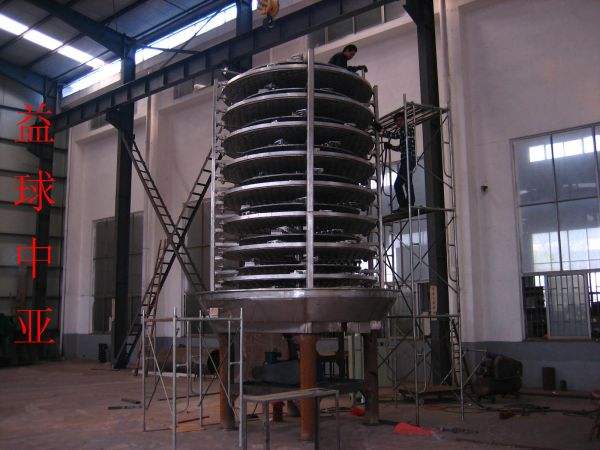
For drying materials that are easily oxidized, highly toxic, or particularly flammable and explosive, inert gas must be introduced into the dryer during the drying process to ensure safety and product quality. In this case, in addition to the basic configuration of a closed-loop disc continuous dryer, auxiliary equipment such as a solvent condenser, solvent receiving tank, inert gas circulator, inert gas replenishment tank, and finned heater are required. The process flow is basically the same as that of the solvent recovery type disc continuous dryer, except that the inert gas drawn from the top outlet of the solvent recovery tank is fed back into the disc continuous dryer after passing through the circulator and finned heater, forming a closed-loop circulation of inert gas.
IV. Drying Paste-like and High-Viscosity Materials
Due to the inherent characteristics of disc continuous dryers, they are suitable for drying granular materials, but not for drying paste-like or high-viscosity materials. In such cases, the material easily sticks to the rake blades and drying discs, making the drying operation difficult. However, in production practice, it has been found that some materials become sticky when their moisture content reaches a certain percentage, but become less sticky when the moisture content is reduced to a certain percentage. This suggests the possibility of taking measures to reduce the moisture content of paste-like, filter cake-like, and high-viscosity materials before they enter the disc continuous dryer. This would expand the application range of the disc continuous dryer and provide a new method for drying paste-like and high-viscosity materials. Therefore, the original general feeder needs to be replaced with a special feeder suitable for paste-like and filter cake-like materials. At the same time, a mixer needs to be added to mix the paste-like material with the dried material to form a loose material with a lower moisture content. To achieve this, the discharge port of the disc continuous dryer is changed to two: one for direct packaging of finished products, and the other for sending the dry material to the mixer via a screw conveyor and bucket elevator. During startup, a certain amount of dry material needs to be mixed with the paste-like material, as there is no dry material discharged from the dryer itself at this time. After normal operation, no additional drying material is needed.
