

The double-cone rotary vacuum dryer is a new type of dryer that integrates drying and mixing. It combines a condenser and a vacuum pump with the dryer to form a vacuum drying unit (the condenser is optional if solvent recovery is not required). This machine features an advanced design, simple internal structure, easy cleaning, complete material discharge, and simple operation, reducing labor intensity and improving the working environment. Simultaneously, because the material rotates along with the container and no material accumulates on the walls, the heat transfer coefficient is high, and the drying rate is large, saving energy and ensuring uniform and thorough drying of high-quality materials.
The double-cone rotary vacuum dryer is widely used in the production of active pharmaceutical ingredients (APIs). This is because during vacuum drying, the pressure inside the cylinder remains lower than atmospheric pressure, resulting in fewer gas molecules, lower density, and lower oxygen content. Therefore, it can dry pharmaceuticals prone to oxidative changes and reduce the chance of material contamination.
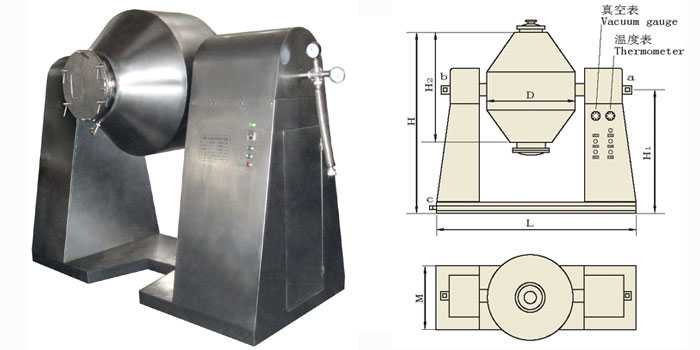
The vacuum dryer has a steel outer shell with a rectangular or cylindrical cross-section and many hollow partitions inside. Steam or hot water is introduced into the partitions, connecting the hollow partitions to multiple branch pipes. Steam is introduced into the main pipe, and condensate is discharged through the branch pipes. A tray containing the material to be dried is placed on the partitions, the chamber door is closed, and a vacuum pump creates a vacuum inside the chamber. The steam in the partitions gradually heats the material in the tray to the specified temperature, causing the moisture to vaporize under the internal pressure and condense in the condenser. The condenser is installed between the dryer and the vacuum pump. If a J21S-70 water ring vacuum pump is used, the condenser is not required. Vacuum dryers have low heat loss and high thermal efficiency, and the chamber can be pre-sterilized before drying. During the drying process, no impurities are introduced, ensuring the product remains uncontaminated. The dried material remains stationary, minimizing damage to its shape. However, vacuum dryers are more complex to operate, have higher operating costs, and are more structurally complex and expensive to manufacture.
