

I. Recommendations for Improving Intake Air Handling
The intake air for hot air is generally located in the auxiliary equipment room, installed together with the heating device and silencer. The auxiliary equipment room and the clean area do not have direct doors or windows. The air cleanliness level in the auxiliary equipment room is often relatively low, which affects the quality of the hot air used for pharmaceuticals. This necessitates that the equipment itself have a good purification system; otherwise, unpurified air will contaminate the medicines, making it difficult to meet GMP requirements.
Currently, many domestic equipment systems configure their air handling units as follows: pre-filter—medium-efficiency filter—steam heating (or electric heating)—(sub)high-efficiency filter. Although the air handling system is equipped with pre-, medium-, and high-efficiency filters, with increasing operating time, the high-efficiency filter may become clogged or damaged. Currently, the need for replacement can only be determined visually, lacking theoretical basis. Premature replacement increases costs, while delayed replacement carries the risk of deteriorating air quality, thus affecting product quality. Recommendation: Add a differential pressure display device before and after the high-efficiency filter. When the differential pressure reaches a certain value, an alarm should be triggered to prompt replacement.
In addition, most equipment lacks dehumidification devices, resulting in persistent air dehumidification issues, especially in late spring and summer when air humidity is high. Failure to dehumidify significantly impacts material drying. Recommendation: Add dehumidification devices.
Many devices lack interlocking between the induced draft fan and the air valve, potentially causing air backflow between fan shutdown and valve closure. Recommendation: Link fan start-up and shutdown with air valve operation. The air valve should open simultaneously when the fan starts and close synchronously when the fan stops to prevent air backflow.
II. Improvement Suggestions for Inadequate Thermal Energy Utilization
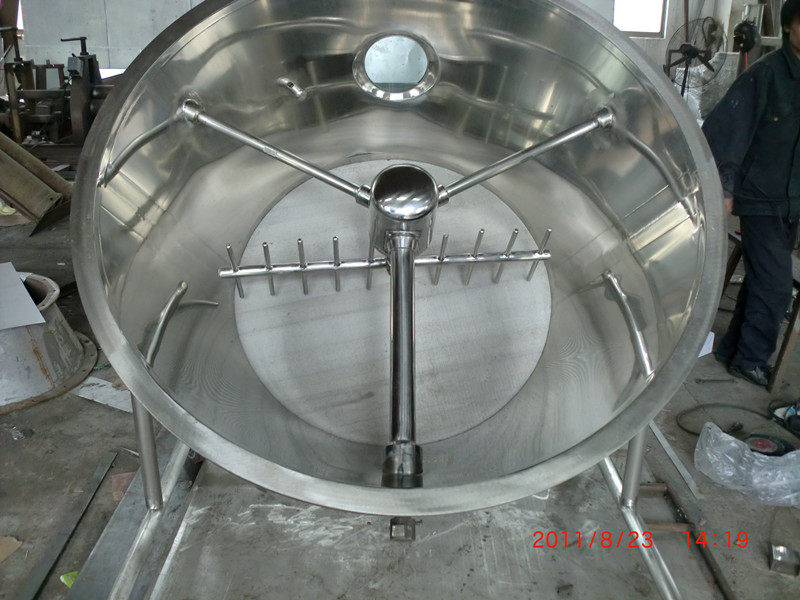
Fluidized bed dryers are, in essence, air convection drying equipment. Compared to conductive drying equipment, their energy consumption is indeed higher. However, with certain measures, significant energy savings can be achieved. Recommendation: (1) Enhance the sealing effect of the equipment. Currently, most fluidized bed dryers use flat flanges to connect the hopper to the main body of the equipment, resulting in poor sealing. It is recommended to use raised face flanges in the design. (2) Many dryers use steel pipes wound with fins for heat exchange. Although steel pipes can save material costs, the heat exchange effect is not good. It is recommended to use copper pipes instead. (3) Increase insulation measures by adding an insulation layer to the shell of the heat exchanger to reduce heat loss.
III. Suggestions for Improving the Dust Collection Device
The basic condition for the smooth operation of fluidized bed processes is that the material has a good fluidization state. A high-efficiency filter dust collector allows this state to continue. The dust collection efficiency of the filter dust collector largely determines the fluidization effect. Currently, the main dust collection methods are bag shaking dust collection and pulse backflushing dust collection.
Bag Shaking Dust Collection
The dust collection effect is achieved by shaking the collection bag through the reciprocating motion of the cylinder. The bag is made of antistatic, non-fiber shedding cloth, and the collection bag is hoisted as a whole. The problem is that bag filters are inconvenient to install and disassemble, and the improper selection of suspension rods can easily cause deformation, leading to poor sealing, dust leakage, and changes in airflow. This pollutes the environment and reduces product yield. Recommendation: Use clamp connections for filter bags, select rigid materials for the suspension rods that are not easily deformed, and regularly inspect and replace the filter bags.
Pulse Jet Dust Collection
With the further improvement of domestic solenoid valve technology and the further reduction in price, pulse jet dust collection is gradually becoming the mainstream dust collection device. Currently, the main filter elements used are bag filters and stainless steel sintered mesh filters. Among them, stainless steel sintered mesh filter elements can guarantee a yield of over 99% for any material. Since the cleaning technology challenges have been largely solved, the advantages of stainless steel sintered mesh filter elements in terms of yield and service life are gradually becoming apparent, and their use in pharmaceutical plants is increasing.
